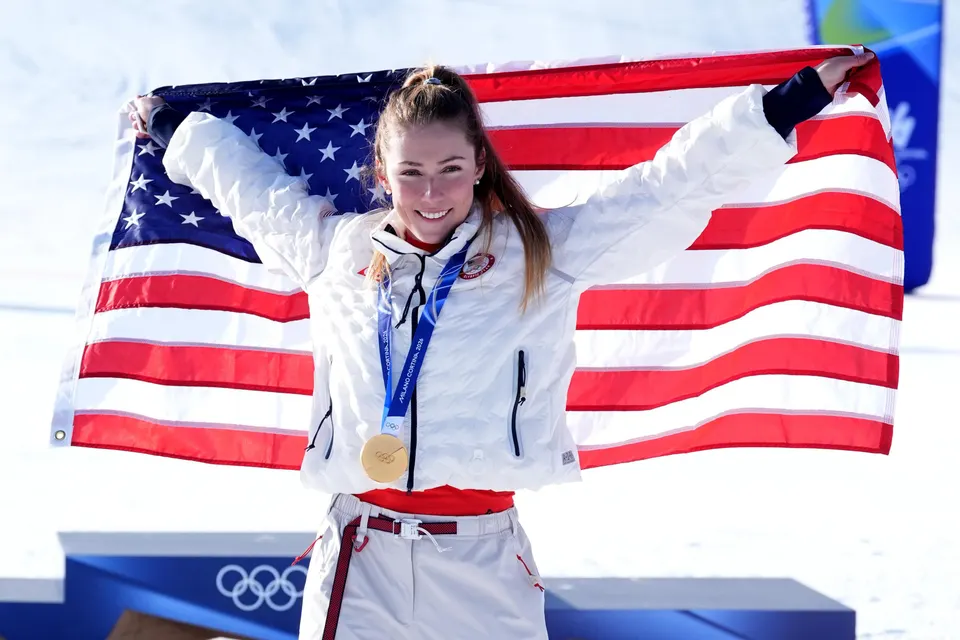
For four years, the world’s greatest skier was reduced to a three-letter acronym: DNF — Did Not Finish. However, in Milano Cortina, Mikaela Shiffrin didn’t just win gold; she redefined her story.
The road to this movement is paved in grief. Shiffrin tragically lost her father on Feb. 2, 2020.
“We lost our rock, the person that we all loved the most,” Shiffrin’s mom said.
Shiffrin took a 300-day break — almost ten months — before returning to the World Cup circuit in Finland.
Two years to the day after losing her father, she headed into the 2022 Beijing Olympics with a demanding six-event schedule. But she devastatingly came up empty-handed. She even skied off the course in the giant slalom after a couple of seconds because she wasn’t lined up for the next gate. Her performance is a reminder that the Olympics boil down to how an athlete performs in exactly one moment that occurs every four years. For many competitors, that moment can become a heartbreaking story.
Going into the 2026 Milano Cortina Games, Shiffrin had an open mind.
“Things won’t go according to plan — and that’s okay,” She said before the games. “It’s so important to be able to enjoy whatever moments you can.”
Shiffrin was the final skier in the slalom, following immediately after Lena Dürr. Ready for her second run, she watched as Dürr skied out of the course only seconds into her run — mirroring Shiffrin’s own heartbreaking DNF in the 2022 Olympics. But, when history threatened to repeat itself, she channeled the pressure into the mountain.
Starting with a 0.82-second advantage in her first run, Shiffrin pulled even further away during her second run to claim the slalom title by a massive 1.5-second margin.
A 1.5-second lead isn’t just a win; it’s domination.
To put that in perspective, in alpine skiing, that big of a lead is sometimes the difference between a medal and the middle of the pack. This is the largest margin of victory since 1998. In a sport where a sliver of a snowflake is the difference between gold and silver, Shiffrin carved a canyon between her and her competitors.
After reaching one of the lowest points of her career, Shiffrin returned to the Olympics and won a gold medal for her country — a testament to perseverance and grit. It was her first gold medal since the 2018 PyeongChang Games and her first Olympic medal since her father’s death.
All gold medals are meaningful, but this gold carries deeper emotional weight and the feeling that she has conquered any athlete’s greatest enemy: her mind.
She proved that grief doesn’t have to bury you. You can navigate challenges and return stronger than before.